Overwatch 2's Arcade faces matchmaking woes and abysmal queue times, forcing Blizzard to rotate modes and use a mystery queue.
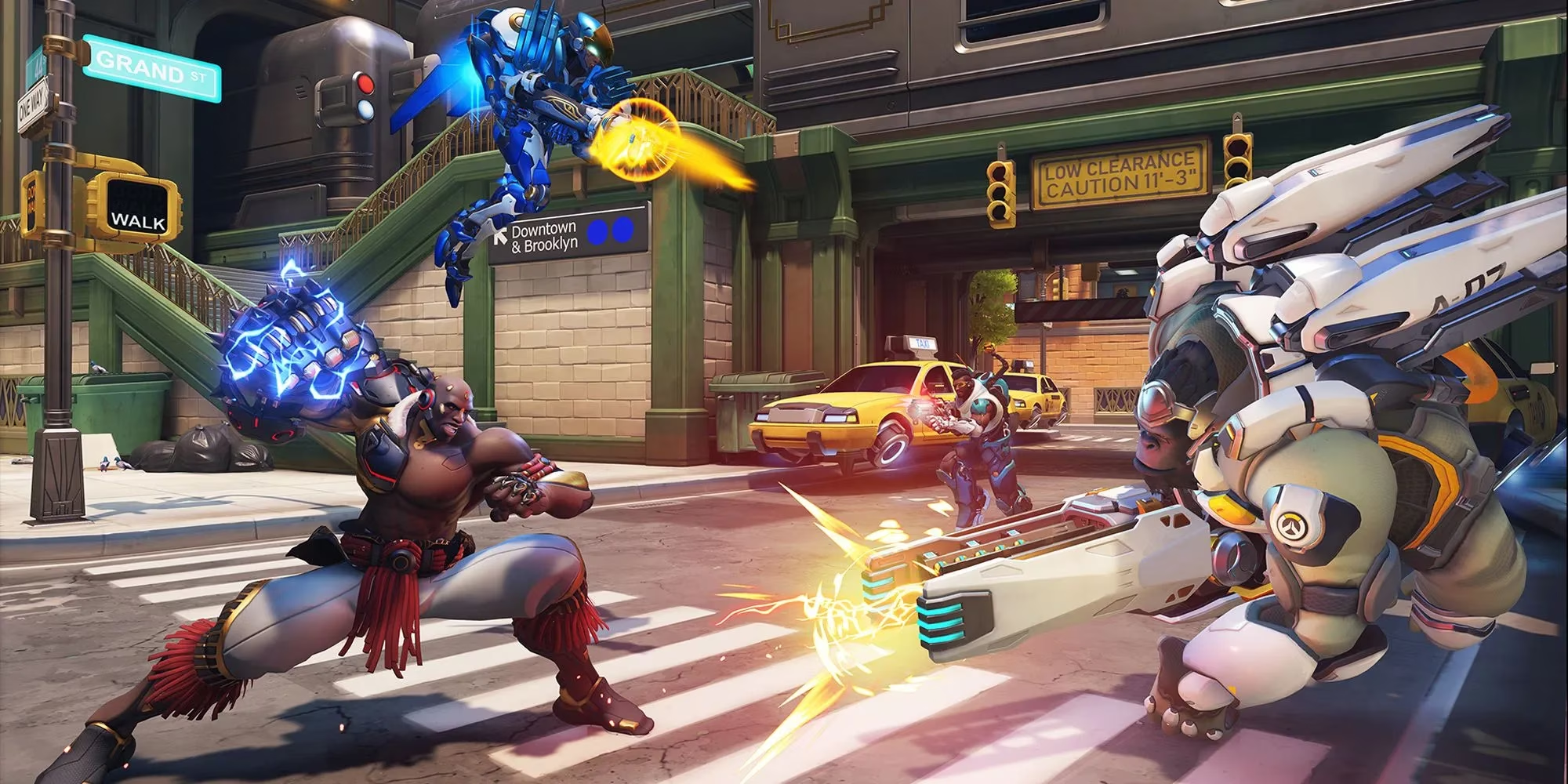
It’s 2026, and Overwatch 2’s Arcade card is still that dusty corner of the menu where you go to question your life choices. Players remember the golden days of the original Overwatch, when the Arcade was the go-to spot for wacky rule sets and quick casual fun. Now? You could bake a cake, learn a new language, or watch an entire season of a mediocre streaming show in the time it takes to find a match. Blizzard has been scratching its head over this for years, and back in the ancient era of Season 3, director Aaron Keller finally admitted what everyone already knew: the Arcade had a slight queuing problem. His words, not ours – but the player base has been a lot less diplomatic.
The core issue, as Keller pointed out way back when, was a classic case of spreading the peanut butter too thin. Too many modes, not enough players, and some truly baffling challenge design that forced people into the Arcade like reluctant gym-goers. The irony is palpable. The team tried to fix things by yanking the most popular modes – Mystery Heroes and Deathmatch – and plopping them into the Unranked card. Great news for anyone who wanted to play those without the wait, but a catastrophic blow to the Arcade’s population. It was like removing the two most popular rides from a theme park and then wondering why nobody visits the rest of it anymore.
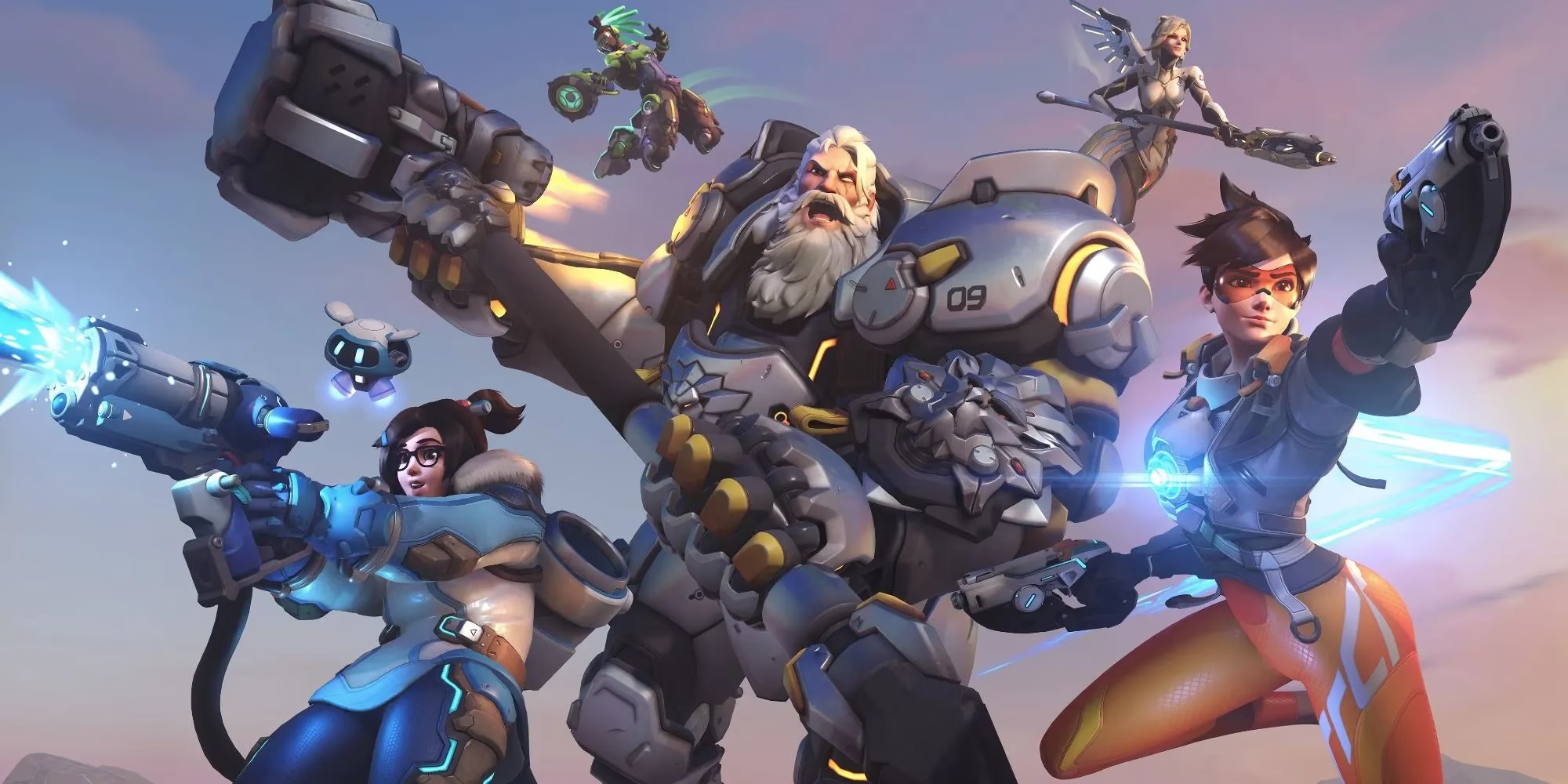
Fast forward to today, and many of Keller’s proposed fixes have been rolled out, tinkered with, and occasionally rolled back, because this is Overwatch 2 we’re talking about – consistency is not exactly a strong suit. The first idea was deceptively simple: rotate fewer modes at a time. Instead of drowning players in 14 different options like an overenthusiastic buffet, the Arcade now offers a slimmed-down selection of three or four modes per week. This forced scarcity did manage to trim queue times from “geological epoch” down to “a long coffee break.” But it also sparked a fresh wave of complaints. Anyone trying to complete a specific challenge for a mode like Total Mayhem or Low Gravity found themselves locked out for days, leading to furious Reddit essays that could fill a small library.
The second, more radical experiment was the rotating queue. Think of it as the Arcade’s version of a mystery box, only you never know if you’ll get a delightful treat or a damp sock. The system lumps several similar modes together – say, Capture the Flag, Elimination, and Limited Duel – and tosses you into whatever has enough players. On one hand, it dramatically sped up matchmaking. On the other, it gave control freaks an existential crisis. There’s nothing quite like loading in expecting a chill round of CTF Blitz and getting thrown into a sweaty 1v1 against a Genji main who hasn’t seen sunlight since the Obama administration. Player feedback has been… mixed. The most common sentiment in forums is a weary “at least I found a game, I guess.”
What’s truly bizarre is that in 2026, the Arcade still feels like Blizzard’s forgotten stepchild. The company has poured resources into shiny new PvE expansions (which everyone insists they want until they actually get them) and limited-time crossover events that sell $30 skins. Meanwhile, the Arcade gets a quiet weekly rotation and the occasional bug fix that inevitably breaks something else. Custom games have siphoned off a huge chunk of the casual audience, offering endless “1v1 AIM TRAINER” and “CHILL NO KILL” lobbies that are always instantly available. Why wait ten minutes for an official mode when you can join a server named “REINHARDT HAMMER ONLY (IMPROVED VERSION)” and have the time of your life?
Of course, Blizzard hasn’t been entirely idle. A barely-announced update last spring introduced a “priority Arcade” system where players could flag one mode per week they desperately wanted to play, and the matchmaker would give it a slight population boost. Think of it as a digital thumbs-up that might shorten your wait by 30 seconds if you’re very lucky. It was a nice gesture, like getting a single french fry when you ordered a full meal. And in true Blizzard fashion, the feature is now bugged for roughly 17% of the player base, causing their client to crash whenever they try to select Mystery Heroes in the Arcade – even though Mystery Heroes hasn't officially lived there since 2022. You can't make this stuff up.
The most hilarious part is watching the community try to game the system. Every time a new rotation drops, there’s a flurry of Discord pings and Twitter polls trying to convince everyone to queue for the same mode so wait times stay bearable. It’s a delicate social experiment that falls apart the moment a popular streamer decides to play something else. And the Arcade challenges? They’ve been reworked at least four times by now, each iteration slightly less infuriating than the last, but still guaranteeing at least one reward is locked behind a mode nobody genuinely enjoys. Collecting 10 Arcade wins for a measly spray is the modern equivalent of Sisyphus pushing a boulder uphill.
So where does all this leave the average player? In a strange limbo where the Arcade is technically functional, mostly faster, but utterly devoid of the chaotic charm that made it special. The rotating queue solved a problem but killed the spontaneity. Fewer modes mean shorter waits but fewer choices. It’s a classic case of Blizzard fixing one thing by breaking another’s spirit. The true Arcade lovers have mostly migrated to custom games or just accepted that getting into a match requires a second monitor and a backlog of YouTube videos. As the game marches toward its next big anniversary, one can only wonder if the Arcade will ever reclaim its former glory, or if it’ll remain Overwatch 2’s biggest inside joke. Queued up and waiting.
Data referenced from The Esports Observer helps frame Overwatch 2’s Arcade woes as a predictable population-fragmentation problem: when too many niche playlists compete at once, matchmaking health collapses unless players are funneled into fewer queues or grouped via rotating bundles. That context makes Blizzard’s “fewer modes” rotation and mixed-mode queue feel less like creative design and more like triage—effective at reducing wait times, but often at the cost of player agency and the Arcade’s old pick-your-chaos identity.