Overwatch 2 Illari guide covers her solar-charged abilities, unique support playstyle, and the dark secrets of her origin story.
If you were around when Overwatch 2 Season 6 dropped back in August 2023, you probably still remember the buzz around Illari. She arrived alongside PvE story missions, the new Flashpoint mode, and a revamped practice range, but honestly, it was this Peruvian support hero who stole the show for a lot of players. Fast forward to 2026, and Illari has become a staple pick in many team compositions—her solar-charged abilities remain as impactful as ever. Yet, even after all this time, the darkness behind her glowing powers still manages to send a chill down your spine whenever you revisit that origin cinematic.
Illari’s kit immediately set her apart from the other supports. She combined healing and damage in a way that felt refreshingly aggressive. Her Solar Rifle could pump out bursts of healing or switch modes to fire precise, high-damage shots. Then there was the Outburst ability that launched her away from danger while knocking back enemies, a healing pylon that stuck to walls and auto-targeted injured allies, and her ultimate, Captive Sun, which let her soar into the sky and rain down a massive explosion that could turn a team fight in an instant. It was no wonder everyone wanted to lock her in during those first two weeks before she even hit competitive play.
The Inti Warriors and the Solar Threading Ritual
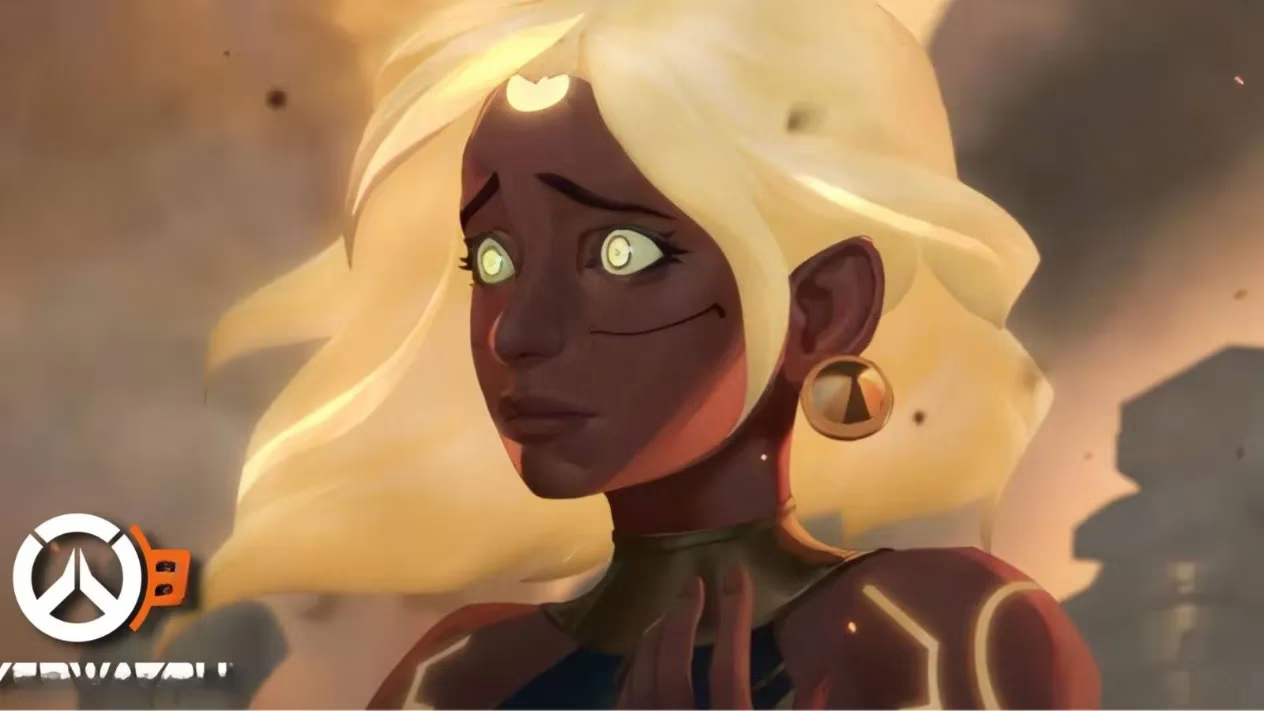
What really caught the community off guard, though, was her backstory. Before Season 6 went live, we knew almost nothing about her. Then Blizzard dropped a cinematic on the PlayOverwatch channel, and suddenly the sunny, confident healer had a devastating secret. In the video titled "Illari Origin Story," she narrates her past as a member of the Inti Warriors, a revered group from Peru who harnessed the sun’s energy to protect, heal, and provide for their people. They weren’t just fighters; they were the backbone of their society, a living symbol of hope.
The most important moment in any Inti Warrior’s life was the Solar Threading Ritual. Think of it as a graduation ceremony mixed with a spiritual awakening. Once an apprentice was deemed ready, they would step into an ancient-looking mechanism and channel their power to officially join the ranks. For Illari, this was everything she had trained for. The cinematic builds up this sense of anticipation and pride, showing her walking toward the ritual site with a quiet determination. You can almost feel how much she wanted to prove herself.
But then things went horrifically wrong. Illari’s power was far greater than anyone—including herself—had realized. In a single, blinding flash, she accidentally overloaded the mechanism. The result? Every single Inti Warrior except her was vaporized. The cinematic portrays this with a brutal, silent shock. One moment there’s a circle of warriors ready to welcome her, and the next, they’re just… gone. The slow realization on Illari’s face as she turns around and sees nothing but empty space is simply gut-wrenching.
A Tragedy Born from Innocence
What makes Illari’s origin so uniquely painful is the absence of an external villain. There’s no evil organization pulling the strings, no Talon agent manipulating events from the shadows. It was an accident—a sheer, catastrophic miscalculation. She didn’t mean to hurt anyone. In fact, she was trying to fulfill her life’s purpose, to become the protector she’d always dreamed of being. And in doing so, she wiped out her entire family and mentor figures in an instant.
The aftermath is heavy with guilt. In the cinematic, Illari’s voice breaks as she says she “will make up for what [she’s] done.” It’s a promise she carries into her eventual association with Overwatch, though how exactly that connection formed remained a mystery for quite some time. During the first few seasons after her release, players speculated endlessly on forums and in Discord servers. Did Winston recruit her? Did she seek out the organization herself as a form of atonement? The vague ending of the origin story only made the community more invested.
How Illari’s Pain Stacks Up Against Other Heroes
Overwatch has never shied away from tragic backstories. Widowmaker was brainwashed by Talon and turned into a cold-blooded assassin after being a loving wife. Mei woke up from cryostasis to discover she was the sole survivor of her entire research team. Hanzo and Genji’s brotherly conflict, showcased in the iconic “Dragons” short, is filled with regret and literal fratricide. Even Ramattra’s descent into extremism is rooted in centuries of oppression.
But Illari’s story hits differently because of its sheer, instantaneous devastation. There’s no slow corruption or enemy to blame—just a young woman who must live every day knowing her own hands are responsible. You can see it in her in-game demeanor, too. She’s quieter than the more quippy heroes, and her voice lines often carry a somber undertone. A casual “I should have seen it coming” or a weary “All that training… wasted” can pop up during matches, little reminders that the guilt is never far from the surface.
That relatability is probably why she resonated so strongly with the player base. Many people have experienced moments where a small mistake ballooned into something terrible, even if the scale isn’t as extreme. Illari’s burden is an exaggerated, sci-fi version of that universal fear. Blizzard’s decision to pair such a radiant, solar-themed hero with such a dark internal conflict was a masterstroke.
The Ongoing Search for Redemption
Since 2023, Overwatch 2 has continued to expand its narrative through seasonal story missions and limited-time events. By 2026, the lore has become a dense web of alliances and conflicts, and Illari’s place in it has grown more defined. Early on, players noticed subtle interactions between her and other heroes. Pharah and Soldier: 76, both veterans of personal loss, seemed to offer a kind of silent understanding. Zenyatta, with his endless quest for harmony, sometimes directed cryptic yet gentle advice toward the young support. These moments hinted that Illari was slowly finding a new family among the Overwatch agents, even if she never stopped blaming herself.
The story missions that followed Season 6’s Invasion arc gradually gave her more screen time. Without diving into spoilers for those who still haven’t caught up, let’s just say she got to confront both literal and figurative shadows of her past. One particular mission set in a sun-scorched ruin felt like a direct callback to the Inti Warrior temple, forcing Illari to walk through environments that must have been agonizing for her. The writing team clearly understood that her trauma wasn’t something that could be “fixed” in a single cinematic; it would be a long, ongoing process.
A Hero Who Keeps Evolving
From a gameplay perspective, Illari received tweaks over the years. Right after launch, her healing pylon was a bit too oppressive—it could sustain an entire backline without much effort. The devs eventually adjusted its uptime and health, pushing players to be more strategic with placement. Her ultimate, Captive Sun, also saw its fair share of tuning. At one point, the slow effect was reduced because skilled Illari players were using it to guarantee team wipes almost every fight. Now, in 2026, she sits in a comfortable spot: strong enough to be a meta contender on certain maps, but not so dominant that she overshadows other supports like Kiriko or Lucio.
What hasn’t changed is the emotional weight she brings to the roster. Every time you select Illari from the hero gallery, there’s a brief moment where her character model stands bathed in golden light, and you remember what that light cost her. It’s a testament to Blizzard’s cinematic team that a two-minute origin story can still feel so vivid years after its release.
Illari’s journey from a well-intentioned student to a grief-stricken wanderer and, eventually, to a member of Overwatch is one of the most compelling arcs in the game. She’s a reminder that even in a world of omnics, genetically enhanced gorillas, and time-jumping pilots, the most haunting monster can be your own past.
Whether you’re a veteran player who’s been maining her since Season 6 or a new recruit who just picked up Overwatch 2 in 2026, her story is bound to leave a mark. And honestly, that’s exactly the kind of depth that keeps the community logging in match after match.