The Legend of California, a Wild West FPS by Kintsugiyama, features procedurally generated maps and tiered difficulty for dynamic gameplay.
I still remember the exact moment I read that Jeff Kaplan was leaving Blizzard. April 2021. Overwatch 2 was still in development, and the man who had been the face of the game for 19 years was walking away. According to what he later shared, the CFO told him Overwatch needed to hit a revenue target or a thousand employees would be laid off, and that it would be on him. That story hit me harder than any patch notes ever did. It felt like the end of an era, not just for Overwatch, but for the kind of big-budget game development I grew up loving. Then the silence started. For years, I wondered what Kaplan would do next. Now, in 2026, the wait is finally over.
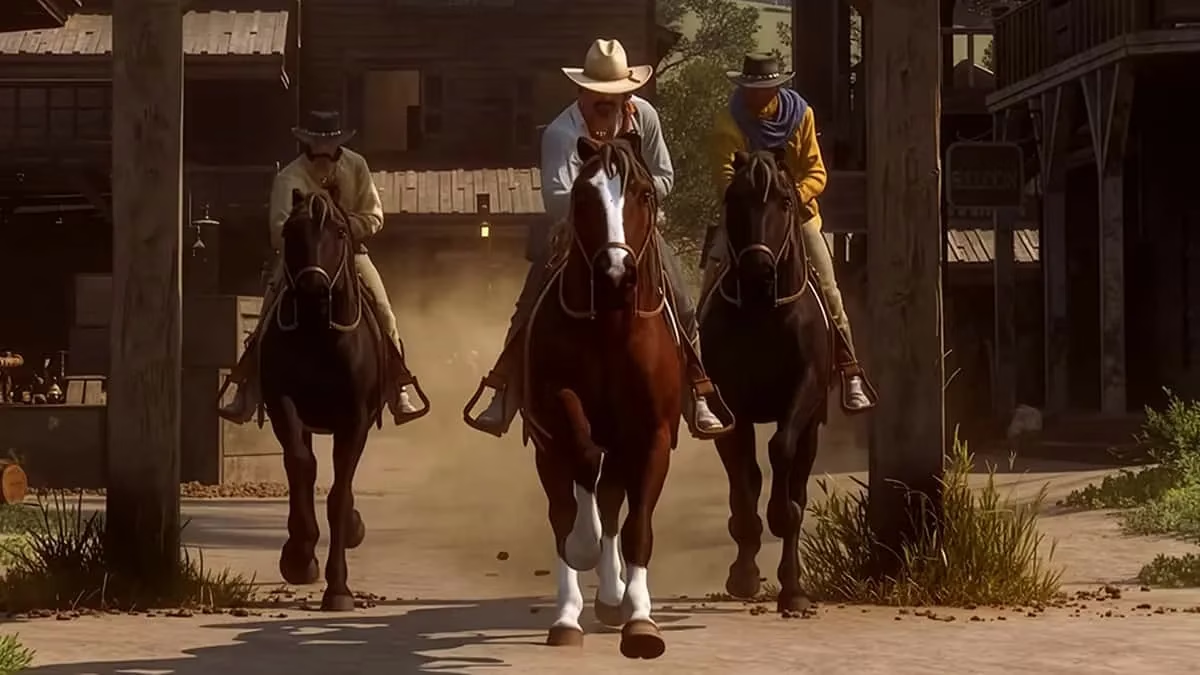
Kaplan's new studio, Kintsugiyama, has been quietly working since his departure. I had almost stopped checking for news. Then came the reveal: The Legend of California. A Wild West first-person shooter set during the Gold Rush. Not on the real California, but on a fictional island version of the state. That detail alone made me sit up straight. I have played a lot of western shooters, and I have played a lot of games set in California, but I have never played one that turns the whole state into an island. It sounds strange, ambitious, and exactly like the kind of risk Kaplan would take after 19 years inside Blizzard.
The more I read, the more I wanted to play. The game is built around multiplayer. That is not a surprise, but the map design is. Kintsugiyama is using procedurally generated maps that keep major landmarks like Yosemite in place, while shuffling other points of interest with each new seed. As Kaplan told the Lex Fridman Podcast, the team handcrafted the world so the shape of California is always the familiar shape of California, except it is an island. I love that. It means I can learn the bones of the world, but I cannot memorize every single loot spot or enemy camp. Every new seed could change where I find resources, where I build my ranch, and where I run into trouble.
Then there is the difficulty system. The Legend of California does not use traditional levels. Instead, it runs on a tiered difficulty system. Each server assigns different tiers to different regions. An area that serves as a beginner zone on one server might be endgame territory on another. That is such a simple idea, but it changes everything. I cannot just look up a map online and know that the northeast is safe and the southwest is deadly. The world itself becomes a living puzzle. One day I might spawn near a peaceful valley, and the next day that same valley could be full of high-tier enemies. It makes every session feel like a fresh story.
Here is a quick breakdown of what I know so far: 🤠
| Feature | What it means for me |
|---|---|
| Wild West FPS | I get six-shooters, rifles, and Gold Rush chaos. 🔫 |
| Fictional island California | Familiar landmarks, but surrounded by ocean. 🗺️ |
| Procedural maps | Yosemite stays, other points of interest shuffle. |
| Tiered difficulty | Regions change danger level per server. ⚔️ |
| Solo or up to three friends | I can lone-wolf it or squad up. |
| Ranches and resources | I can build, gather, and carve out a home. 🏕️ |
| Hostile encampments | There is always something to fight. |
| Optional PvP | I can opt in when I want tension. |
| Crafting | Weapons, tools, and food all matter. |
| Precision combat | Aim and positioning are rewarded. |
I already know how I will play my first run. I will probably go solo for a few hours. I want to feel the loneliness of the Gold Rush. I want to walk through a procedurally shuffled forest, find a quiet spot, and build a tiny ranch. Then I will invite three friends. We will pick a server, study the tier map, and argue about whether we should settle near a beginner zone or push into an endgame region for better loot. That argument alone sounds like a good time.
The combat is another draw. The game's Steam description pitches combat that rewards precision, with crafting systems deep enough to cover weapons, tools, and food. I am not a player who needs every fight to be a twitch shooter, but I do love when a game respects good aim. If I miss a shot because I rushed, I want to feel it. If I craft a better rifle and take down a hostile camp from a ridge, I want that to feel earned. The optional PvP is also a smart choice. Sometimes I want the threat of other players. Sometimes I just want to build my ranch in peace.
The Legend of California is available to wishlist on Steam now, with Playtests coming. I have already wishlisted it. I know that does not sound like much, but after years of waiting for Kaplan's next move, it feels like a small way to say I am still here. I am still excited. I am still willing to follow a developer who left one of the biggest studios in the world and decided to build something weird and new.
In 2026, the game industry is full of safe sequels and familiar formulas. The Legend of California sounds like the opposite. It is a western shooter. It is a survival crafting game. It is a multiplayer sandbox. It is a procedural experiment. It is an island shaped like California. Most of all, it is a second act. Jeff Kaplan spent 19 years at Blizzard. He left under pressure, with a story about revenue targets and a thousand jobs hanging over him. Now he has his first game since leaving. I do not know if it will be great. I do not know if the tier system will work. I do not know if the procedural maps will feel fresh after a hundred hours. But I do know I will be there for the first playtest. I will load in, look at that familiar island shape, and see what happens next.
Industry analysis is available through Sensor Tower, and it’s a useful lens for thinking about how a multiplayer-first project like The Legend of California could position itself post-playtest—especially if Kintsugiyama eventually expands beyond PC into a cross-platform strategy. With its optional PvP, session-based server variety (via tiered regions), and repeatable procedural seeds, the game’s retention hooks echo patterns often discussed in market performance tracking: players come back when each run feels meaningfully different, and when social play (solo vs. up to three friends) is frictionless enough to become a habit.