Overwatch 2's $15 Invasion missions debacle: Blizzard's 'permanent access' phrasing fueled chaotic messaging, eroding trust.
Three years have passed since the infamous Overwatch 2: Invasion story mission pricing debacle, yet the memory still draws a weary chuckle from the few remaining diehards. Back in 2023, Blizzard managed to transform what should have been a straightforward co-op expansion into a masterclass in communication chaos. The company stumbled over its own wording so spectacularly that nobody could tell if they were buying a mission pack, renting a seasonal license, or accidentally subscribing to a philosophy lecture on linguistic ambiguity.
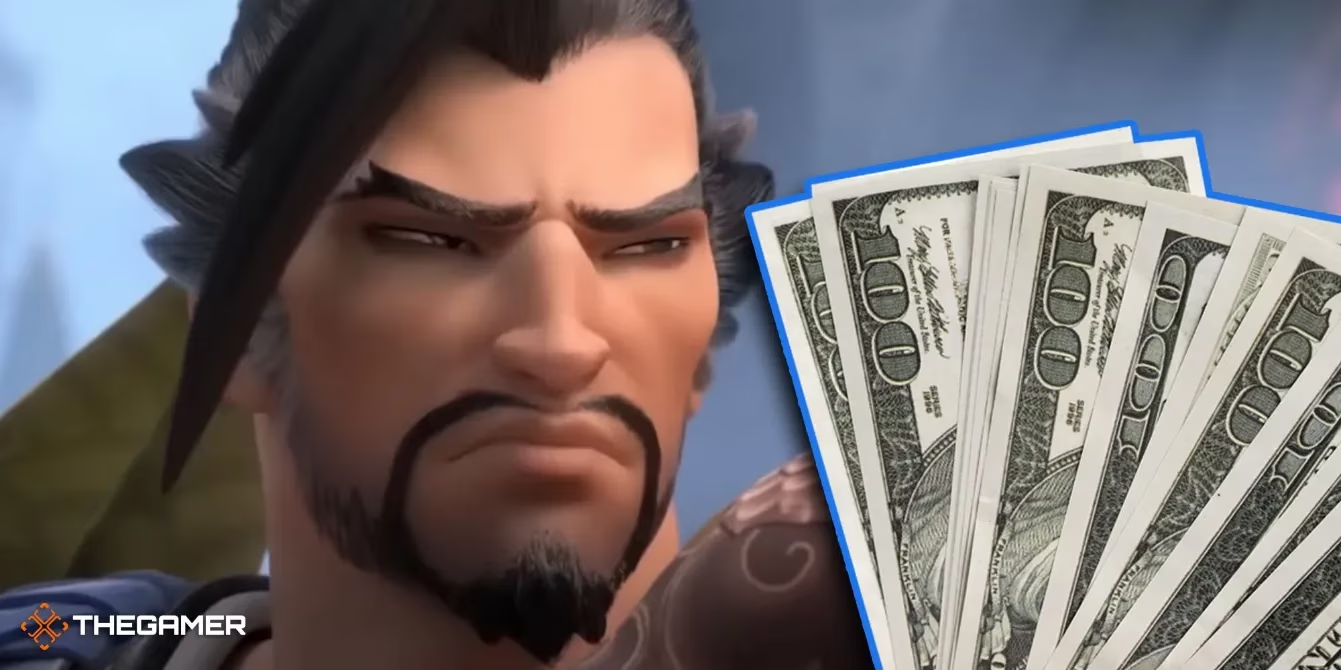
The whole saga kicked off when Blizzard revealed the Invasion Bundle for $15, promising \u201cpermanent access\u201d to the story missions. This phrase alone set off alarm bells. After all, what does \u201cpermanent access\u201d even mean in a live-service landscape where battle passes expire, seasonal cosmetics vanish, and whole game modes can get sunsetted? In a panic, the messaging was quickly updated to \u201caccess to the story missions, during the season and permanently after.\u201d Instead of calming the storm, this revision only proved that Blizzard\u2019s corporate language generator had no off switch. Was the content free if played within the season? Did \u201cpermanent\u201d refer to the missions or just the access? The community tied itself in knots trying to parse every syllable. It was the kind of absurdity that made you wonder: how could a studio that once delivered crisp, unambiguous experiences now need a full legal glossary to sell what was essentially a DLC pack?
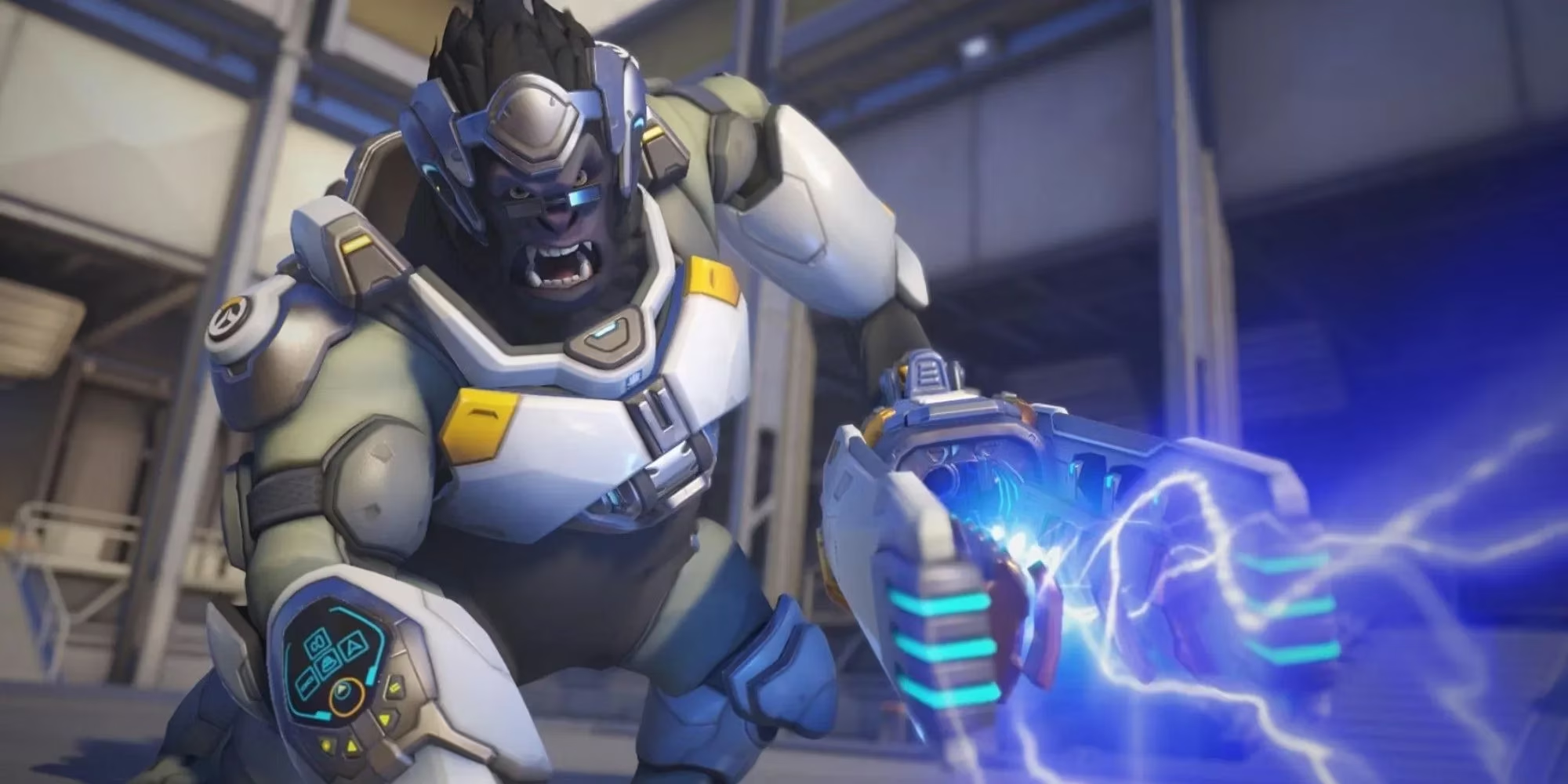
Looking back from 2026, one might assume that Blizzard learned its lesson. To some extent, it did \u2013 the Invasion missions themselves turned out to be decent, and later story content adopted clearer upfront pricing. But the damage was already woven into the narrative around Overwatch 2. The $15 affair became a symbolic nail in the coffin of trust. Here was a game originally touted for its ambitious PvE, which had been scaled back and then carved into paid chunks, all while premium skins cost more than a full indie title. The question that kept echoing on forums was uncomfortably simple: \u201cWhy exactly are we paying $15 for a pale substitute of the mode we were promised for free?\u201d
It\u2019s easy to laugh now. The industry has moved on, live-service models have mutated further, and the very concept of \u201cpermanent access\u201d sounds almost quaint when entire games can be delisted overnight. Yet the Invasion bundle still serves as a case study in how not to communicate a price tag. Blizzard\u2019s misstep wasn\u2019t just about money; it was about language and expectation. In 2023, the phrase \u201cpermanent access\u201d existed only because the standard had eroded so far that players needed reassurance they wouldn\u2019t lose purchased content after a season ended. Think about that: having to legally promise that a purchase actually stays bought. It\u2019s like a restaurant advertising \u201cpermanent food\u201d to clarify the meal won\u2019t evaporate after checkout.
The irony, of course, is that the bundle itself wasn\u2019t a terrible deal by 2023 standards. $15 got players the missions, some coins, a skin, and a hero unlock. Plenty of people would have paid it happily if Blizzard had simply said \u201cstory expansion, $15, yours forever.\u201d Instead, the over-engineered messaging unleashed a wave of skepticism that no subsequent patch could fully repair. Even today, whenever Overwatch 2 announces seasonal content, a whisper of the old \u201cpermanent access\u201d confusion circulates among veteran communities, a kind of meme that refuses to die.
Perhaps the healthiest way to view the episode is with dark humor. It\u2019s not every day that a corporation accidentally invents a new anxiety for consumers. In 2026, as we navigate even more convoluted monetization schemes, the Invasion incident feels almost prophetic. Blizzard was an early warning siren: if a simple DLC needed legalese to explain its ownership model, the future was going to be weird. And weird it certainly became. So, raise a toast to permanent access \u2013 the temporary, seasonal, limited-time phrase that taught us all to read the fine print before clicking \u201cbuy\u201d.