Roadhog's 2026 Overwatch 2 rework nerfed his one-shot hook combo, reducing damage and hook reliability, making him a team-reliant tank.
In the ever-churning wheel of Overwatch 2's hero roster, certain characters wear their power like an ill-fitting suit—fraying at the seams and constantly threatening to burst wide open. By 2026, Roadhog had become that suit, and the seams were screaming for mercy. For more than a year after the game's launch, the big lad had been a walking, breathing “delete button,” his scattergun and chain hook turning skirmishes into unilateral executions. Then the developers, tired of watching the pig-shaped domino knock over the entire meta, finally tightened the screws on everyone's favorite one-man apocalypse.
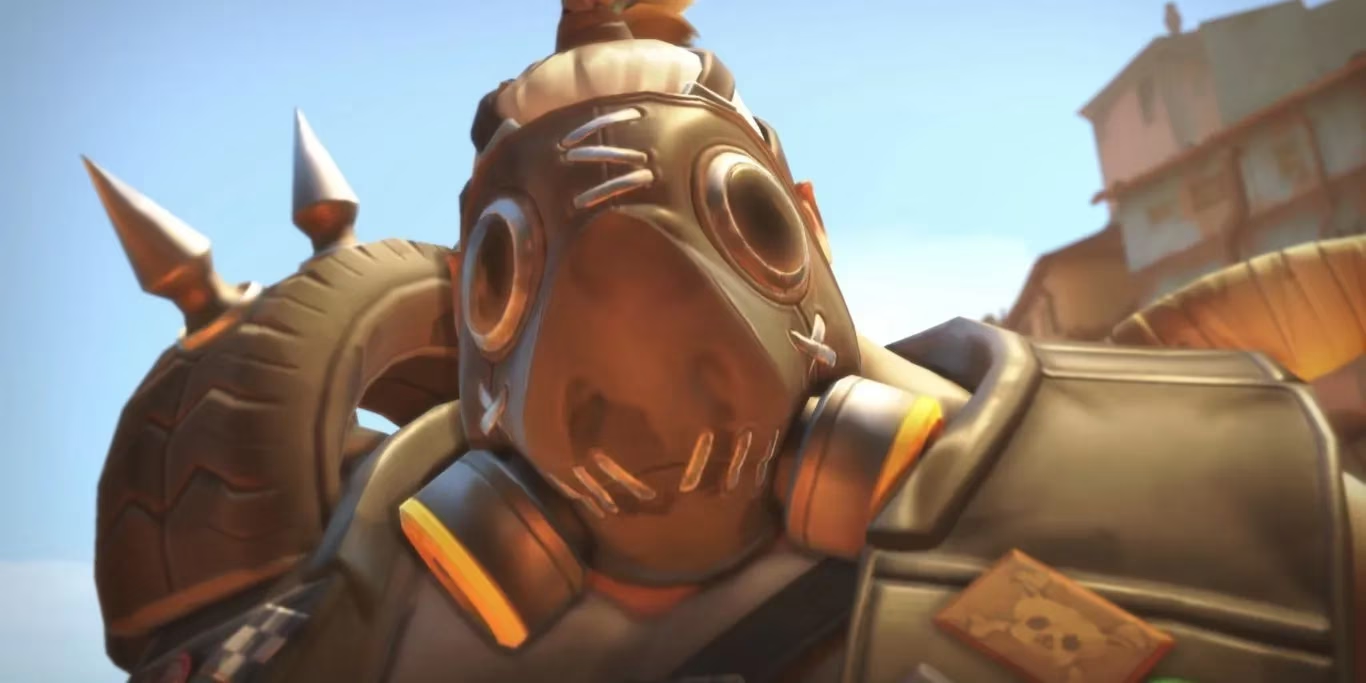
The rework saga had been simmering since late 2022, when lead hero designer Alec Dawson first waved the red cape of change. Back then, the problem wasn't that Roadhog had been buffed into a monster; it was that Overwatch 2 had reshaped the battlefield around him like a tailor adjusting a jacket for a gorilla, inadvertently turning every fight into a pig roast. With one less tank on each side, his hook became less of an opening pick and more of a garotte—any squishy hero who wandered into a 20-meter radius was practically volunteering for a respawn screen. Aaron Keller, the game's director, once described the predicament with the delicate precision of a man disarming a bomb: “It would be very easy for us to change him so much that he becomes unplayable, or nerfed so hard that people would think he was a throw pick. We’d like to avoid that.”
And avoid it they did, but not without turning Roadhog’s damage dial from \"catastrophic\" to \"merely alarming.\" The soft rework that rolled out in the spring of 2026 was a masterclass in surgical subtraction. The signature Scrap Gun saw its maximum pellet damage trimmed, transforming his point-blank alt-fire from a guaranteed one-shot into a stern suggestion that you really ought to retreat. His Chain Hook—once a heat-seeking harpoon that could snatch a teleporting Tracer from another dimension—now had a longer cooldown and a slightly narrower latch window. To compensate, his Take a Breather gained a trickle of damage reduction while active, but the old, oppressive self-heal burst was gone, replaced by a gradual, over-time effect that made him more of a sponge and less of a phoenix rising from its own ashes.
For the Roadhog mains who had spent seasons farming endorsement level 1 with glee, the changes felt like watching a beloved monster truck get retrofitted with a Prius engine. The hook combo, once a rhythmic dance of death—hook, shoot, melee, laugh—now required teamwork to secure kills. Lone-wolf flanking Hogs found themselves out of breath, their kills peeled away by attentive supports. The community quickly splintered into two camps: those who mourned the loss of their one-man wrecking ball, and those who celebrated the end of “Hog-watch,” where every game devolved into two fat boars staring at each other over a funnel of pain.
Yet the rework wasn't a funeral dirge—it was an evolution. Roadhog's role shifted from a hyper-aggressive assassin to a midline bully, capable of displacing enemies, absorbing fire, and creating opportunities rather than instant graves. His new gameplay loop echoed Keller’s philosophy of avoiding “mechanics that can be frustrating, or stifling to play against” when a hero becomes too powerful. The hook still punished poor positioning, but it no longer felt like an unavoidable sentence handed down by a gloomy, gas-masked judge.
And while Roadhog was getting his tusks filed, the Overwatch 2 sandbox continued to expand. In the same 2026 patch that brought Hog's makeover, Blizzard teased two more support heroes arriving later in the year—rumored to be a sound-bending DJ and a battle-hardened ex-Talon medic—alongside the return of the beloved 2CP mode in Arcade, now rebalanced for the 5v5 format. The long-delayed PvE campaign, finally released in episodic chunks throughout 2024 and 2025, had cemented itself as a narrative backbone, and the team seemed more determined than ever to keep the live-service machine humming without letting any single hero become the axis upon which the entire game spun.
What lessons does this porcine parable leave behind? Roadhog in 2026 stands as a monument to iterative design: still a formidable force, still capable of turning a fight with a well-angled hook, but no longer the embodiment of ( \text{frustration} \times \text{damage} = \text{uninstall} ). The rework was like replacing a sledgehammer with a precision mallet—both hurt, but one lets you stand a chance of getting up afterward. For the battered supports and DPS players who once trembled at the rumble of his apron, it's a brave new world. For the Hog enthusiasts? Well, there’s always the next brawl, and a good pig knows when to charge—and when to let his team share the bacon.
🐗💥💪
| Aspect | Pre-2026 Roadhog | Post-Rework Roadhog |
|---|---|---|
| Hook Combo | Solo one-shot for most 200-HP heroes | Requires follow-up fire from teammates |
| Self-sustain | Burst heal with damage reduction | Gradual heal over time, moderate DR |
| Ultimate | Flank-wiping Whole Hog | Zoning tool that punishes corridors |
| Role | Rogue tank-assassin | Team-oriented disruptor |
As the meta churns forward like a hungry sandworm, one truth remains: a well-fed Roadhog is still a terror, just one that now needs a little help from his friends to turn the tide. And for everyone else, the hook’s whistle might still be the scariest sound in the game—but at least it’s no longer a promise of instant retirement.